


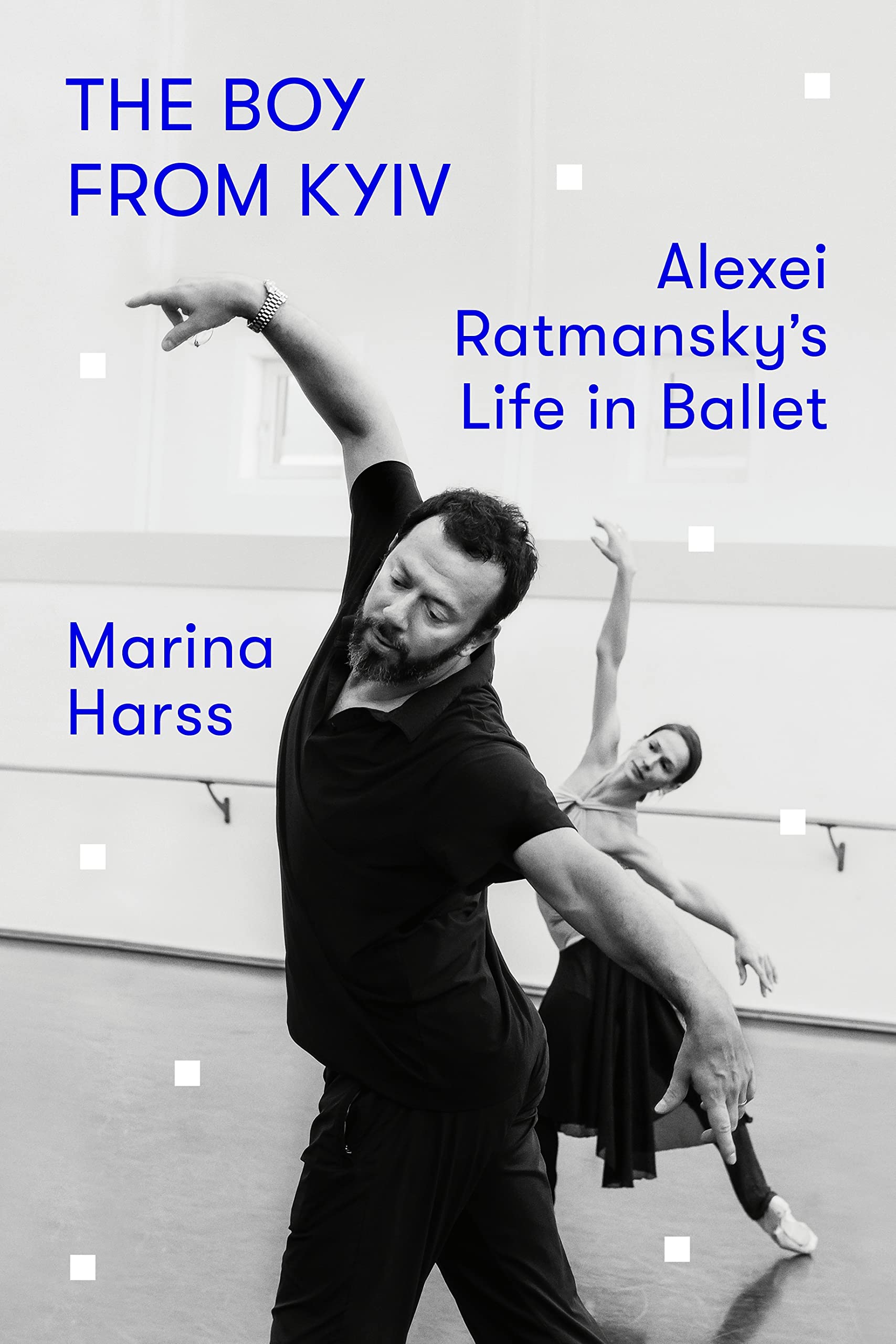
The Boy from Kyiv: Alexei Ratmansky's Life in Ballet by Marina Harss
Impressively thorough and impeccably informed, this biography of the Russian-born and Ukraine-raised international choreographer Alexei Ratmansky is more than a journey through a storied and celebrated life in the arts. Firmly founded on personal interviews with the subject himself, his spouse, professional colleagues, dancers, dance company employees, rivals, and critics, it provides a highly detailed and fully human portrait of a creator and his drive to create. Harss not only provides Ratmansky’s personal chronology and professional itinerary, she delves into the many sources of his inspiration and his quest to coalesce his classical ballet and regimented Russian training with techniques absorbed during his tenure dancing in the Royal Winnipeg Ballet—where he expanded earlier youthful experiments in choreography into works for company performance and public consumption—and at the Royal Danish Ballet, where he was significantly influenced by the Bournonville style of movement and mime.
Through increasing experience and knowledge, relying on limitless imagination, Ratmansky translated the musicality and brio of his own stage performances into a choreographic style. Through a marriage of high classicism and accessible modernism, he often explores Soviet themes and history, expressed with irony and humor and typically performed to favorite Russian composers (Shostakovich, Prokofiev, Rimsky-Korsakov, and Rachmaninoff). Harss examines Ratmansky’s passion for remaking canonical ballets at the major companies around the world—Paquita, Sleeping Beauty, Swan Lake, Giselle—based on his painstaking and dedicated study of original dance notation and character presentation. In these efforts he is ably assisted by his wife Tatiana, a Ukrainian former dancer and constant presence in his private and professional life. The tragic coda, Vladimir Putin’s 2022 invasion of Ratmansky’s beloved Ukraine, affects his sense of identity and instantly ruptures long and fulfilling relationships with Moscow's Bolshoi ballet and other Russian companies where his works were created and performed, whether to acclaim or criticism.
In this outstanding and revealing biography, its subject’s achievements as well as his ambitions—and his self-doubts—are movingly presented. Rehearsals and performances are presented with clarity, and ballet steps are effectively described, enabling the read to follow and understand the kinetics of dance. Regardless of one’s familiarity with Ratmansky and/or his ballets, this is an illuminating and informative work, and therefore highly recommended to both passionate and casual fans of the dance, and anyone interested in the process of artistic growth. (Farrar, Strauss and Giroux, 496 pp., hardcover/ebook, October 2023)

It Happened One Fight by Mareen Lee Lenker
Strong-willed film star Joan Davis, an amalgam of cinema dames Joan Crawford, Bette Davis, and Barbara Stanwyck, is desperate to recover from being labeled “box office poison.” Her prior on-screen partnership with rising heartthrob and prankster Dash Howard (modeled on the early-career Clark Gable) faltered after a very public altercation. When the studio re-pairs them in a dramatic film set at a Reno divorce ranch, as with the best screwball movies, mayhem ensues. Echoes of the Golden Age classic It Happened One Night are embellished with twists that include an inconvenient revelation of the protagonists’ marital status, an even more inconvenient love affair, the place of ambitious women before and behind the cameras, and the machinations of a malevolent and self-important gossip columnist (clearly inspired by Hedda Hopper and Louella Parsons). The combination of factors results in an agonizing betrayal and threaten to destroy the main characters’ personal and professional lives. A fun and pacy debut, with appeal for fans of Hollywood’s wittiest and most glamorous era. (Sourcebooks, 384 pp., paperback/ebook, July, 2023


Double Decker Dreams by Lindsay McMillan
The impact of British rom-com films on impressionable management consultant Kat results in a surprising relationship during her six-week work stint in London. Her determined climb up the corporate ladder results in a work from home gig in a flat with a bus stop view. Repeatedly spotting an attractive morning commuter who personifies her romantic fantasy of a posh British aristocrat—or royal—she decides to pursue him. But the reality of Rory is a disappointment, because her crush turns out to be a fellow Yank, a primary school teacher who has a hometown honey back in the States. However, these unfortunate facts don’t preclude a supportive friendship, which blossoms into a conflicted romance at the same time Kat must navigate a problematically masculine workplace. The combination of lightness and depth, and the London setting will find favor with fans of films and novels based on similar American-in-Britain tropes. (Alcove Press, 336 pp., paperback/ebook/audio, June, 2023)

In her debut work of fiction, Laura Spence-Ash charts the lives and longings of her characters during the World War II years, and in subsequent decades, as relationships and connections and identities shift. As a young girl, Beatrix is shipped by her parents to the Gregory family in Massachusetts remove her from the dangers of the London Blitz. The reluctant evacuee’s assimilation into the upper-class American household, a sharp contrast to her own, is complicated but eventually solid and complete. Each of the section is identified by its viewpoint character—Beatrix; her parents; each of the adult Gregorys; their vastly different sons, Gerald and William, and others entering the story later. The Maine cottage where Beatrix and her hosts spend every summer serves as an anchor and a talisman, until financial straits and advancing age take a toll on family members. Living up to expectations, one’s own and those cherished by others, and the attendant difficulties, are a consistent theme.
At the conclusion of the war, Beatrix is reclaimed by her surviving parent, returning to a London altered by time and destruction. Unable to feel wholly at home, she must forge her own professional path while struggling to find a compatible partner in romance.
The only (relatively minor, but recurrent) flaw is an accurate degree of Englishness in the English characters, whose Americanisms in speech and narrative can be jarring. Overall, the writing is beautiful and insightful, and tragedy and heartbreak are exquisitely rendered throughout. (Celadon Books, 368 pp., hardcover/ebook/audio, March, 2023)

Robb’s analysis, primarily written from the female perspective, of the pleasures and perils and psychology of the dancer’s life is based on personal experience as well as a synthesis of other ballet performers’ careers, either from their memoirs, biographies, or interviews. Some, like Margot Fonteyn or Misty Copeland or Gelsey Kirkland, are well known beyond their respective generations. Others have toiled in near-obscurity, pursuing the elusive goal of perfection in their art. Admitted to New York’s School of American Ballet (SAB), founded by famously dictatorial choreographer George Balanchine, Robb is unable to meet the superior standard required of aspirants to the New York City Ballet or American Ballet Theater. She is eventually excluded from the rarified profession she desires.
Her more fortunate classmates suffer similar—though well-concealed—doubts and stress. Their careers are hampered, even destroyed, by injury, overwork, and exhaustion. Or worse, what cannot be altered—a body type or skeletal that may appear outwardly normal but is deemed by teachers and administrators as a distortion of the ideal. The need to “lengthen,” a euphemism for weight loss, and the constant assessment and criticism of physical flaws, result in eating disorders and persistent body image trauma. Spending an entire day in a mirrored studio or classroom has lifelong consequences, even for those who abandon or are driven out of ballet.
Hidden from the appreciative and awed audience is the agony imposed by the constricting pointe shoes and the various foot injuries and blemishes beneath the pink satin. For the dancer who is training or rehearsing, pain equal progress, and therefore must be ignored. There are many more professional hazards: sexual bullying or predation by superiors, a dependence upon being constantly told what to do at all times, and the oddly contradictory de-sexualizing effects of being partnered by a male dancer, which involves intimate touching of all body parts and extremely close physical proximity.
And yet, despite its adverse impacts, the spell cast by ballet doesn’t necessarily dissipate disappointed dancers mature and move on. Robb charts the second acts of those of her contemporaries and former classmates as they seek less demanding forms of dance, for exercise of pleasure, or decide to follow other creative pursuits—writing, painting, filmmaking. And some strive to teach ballet technique in a more balanced and sensitive fashion than the one that formed them.
A welcome and highly perceptive addition to the growing list of books examining dance and dancers, this illuminating and incisive work is a well-written and rewarding read. (Mariner Books/HarperCollins, 304 pp., hardcover/audio, February 2023)