HOME     ABOUT      CONTACT      MEDIA     BOOKS:   Historical     Contemporary


"I don’t change the facts to enhance the drama. I think of it the other way round, the drama has got to fit the facts,
and it’s your job as a writer to find the shape in real life."
Hilary Mantel


Apr 14, 2015

Some Thoughts on Book Launch Day


For more than a decade their story has thrilled, obsessed, and consumed me. Today I am delighted to be able to share it with the reading public. A Pledge of Better Times is the story of Lady Diana de Vere, daughter of the 20th Earl of Oxford, Charles Beauclerk, illegitimate son of King Charles II and actress Nell Gwyn, and Diana's friend, Queen Mary II of England.


My heartfelt thanks to everyone who supported me in various ways during this lengthy effort to finish my 12th novel and see it published. Writing is regarded as a solitary occupation, but in fact no writer can be fruitful or sane without the presence and assistance of others. The phrase 'it takes a village' comes to mind. And it most definitely takes an entire writing community to nurture and sustain my creative life.


This photo from August 2005 shows my workspace view at our lake cottage. That pale pink binder was my earliest research notebook. When down by the water, I either composed on my Alphasmart keyboard or wrote in longhand.


The photos below were taken during the first of two UK trips in 2006. I was visiting Hampton Court Palace, to view the lovely full-length portrait of Diana de Vere, 1st Duchess of St Albans, a portion of which graces the cover of my novel.


No, it didn't take me all of 10 years to research and write this novel. Along the way there were distractions and other demands upon my time. I served two terms in my state's Legislature. I was involved with two diocesan bishop search committees. I volunteered with other nonprofits. I travelled--admittedly most often to England, Holland, Belgium, and France--in pursuit of my characters.

Discovering everything I possibly could about Charles Beauclerk, 1st Duke of St Albans, his relationship with Lady Diana de Vere, her father the Earl of Oxford, and Queen Mary II of England has been at times frustrating, humbling, and exhilarating.

In November, as the book was about to go to press, I discovered a hitherto unknown portrait of Diana. Was it my reward for at long last reaching the end of our journey together? I like to think so.


A Pledge of Better Times is available in print ($14.95) and ebook ($5.99) at the following vendors:

Mar 21, 2015

Historic Roses

My latest blog post at English Historical Fiction Authors, featuring historic roses from my own gardens.

By Any Other Names: Historical Roses


Feb 24, 2015

Feb 9, 2015

A Pledge of Better Times Book Trailer


A promotion for the upcoming novel, distilled! Hope you enjoy it.

Jan 26, 2015

The de Vere Family in the 17th Century


For information about the illustrious family of Lady Diana de Vere, female protagonist of A Pledge of Better Times, visit my blog post at English Historical Fiction Authors: The de Vere Family in the 17th Century.


Diana, 1694

Diana's father, Aubrey de Vere, 20th Earl of Oxford

Diana's mother, Countess of Oxford


Diana's grandfather, Robert, 19th Earl of Oxford


Jan 20, 2015

A Pattern for Future Ages: The First Duchess of St Albans


Diana, Duchess of St Albans
On this date in 1741/2, the 1st Duchess of St Albans was laid to rest in St George's Chapel beside Windsor Castle.


St. George's Chapel, Windsor Castle
Born Diana de Vere, she was the eldest surviving daughter of Aubrey de Vere, 20th and last Earl of Oxford and his countess. A renowned beauty at the court of William and Mary, in 1694 she married Charles Beauclerk, 1st Duke of St Albans, son of King Charles II and his actress mistress Nell Gwyn. After the Hanoverian succession, Diana served Princes Caroline of Wales, King George I’s daughter-in-law, as First Lady of the Bedchamber and Groom of the Stole.

My intensive study of Diana—and of the man she married—began more than a decade ago. In that time I’ve discovered so much about her: where she was most likely born (a house her father built in London's St James's Square), how she lived, what others thought of her, the colour of the horse her husband purchased for her in Newmarket, the jewels and objets d’art she possessed, each of her pregnancies and its outcome, her children’s births and and careers and death dates. And so much more than I could possibly fit into a work of fiction. It became an intimate acquaintance.

In writing a novel about a real person, whether or not the death occurs in the course of the story (spoiler: hers does not), contemplating that event causes a certain peculiar pain.
Her exact birth date is uncertain but her death date is known. She died on 15 January, 1742 (New Style) at Burford House, the palatial residence inherited from her husband (who died in 1726, at Bath, where he was taking the cure).

Burford House and part of its formal gardens during Diana's lifetime

During her final year Diana suffered from illnesses, presumably age-related. In August of 1741 Lady Hertford writes to Lady Pomfret about her visits to Burford House, comparing the invalid's existence to that of another mutual friend:
Mrs Blount's manner of living appears to me a more proper object of envy than pity, and I have often thought the same of the Dowager Duchess of St. Albans, when I have visited her at Windsor, and found her sitting in a delightful room, furnished with extremely good pictures, and a large glass case full of all manner of varieties . . . and in every corner, stands with large basons full of flowers placed on them. This apartment looks upon a very pretty garden; and behind it, her chapel and closet run parallel with a little terrace ; but this she only looks on, for she never goes out of the door of her house, nor up a step in it : yet, till this last illness, she always appeared chearful and healthy, and much handsomer than most people that we see in public, or than she herself did, in the latter part of the time that she appeared there. I believe her pleasures in her solitude are owing to the goodness of her heart than the attainments of her head . . . the part of the day which is not employed in her devotions, is generally passed in receiving visits, and talking of news.
Five months after this letter was written, Diana died. Though her age went unreported, she would have been in her middle or late sixties. Those of her family not in residence at the time attended her burial. According to Horace Walpole, writing a correspondent on 22 January, “Five of our members were gone to the York election, and the three Lord Beauclercs [sic] to their mother’s’ funeral at Windsor, for that old beauty St Albans is dead at last.” The three sons were Lord Vere, Lord Henry, and Lord Sidney Beauclerk. The “at last” is further evidence of Diana's state of decline during her final months.

Expences for her interment amounted to £37 10s 6d. On 1 February, 1742, shortly after her burial, permission for a marker was granted: “Agreed that Leave be given to erect a Monument for the late Dutchess of St. Albans . . ..” in Rutland Chapel.

Although that particular chapel is off-limits, in November 2014 I was given permission to enter. A verger admitted me, and kindly left me there to privately commune with the spirit of my heroine. Her gravestone is no longer in existence, although she was probably laid to rest near her contemporaries whose slabs remain.
Diana's Will

Her last will and testament, dated 8 August, 1734, disposes to her sons the estate she inherited from “my late most beloved husband deceased.” In a codicil she makes additional bequests of capital sums and personal items belonging to her, as follows:
to Lord Henry Beauclerk (son) £1000
to Lord George Beauclerk (son) £1000
to Lord Aubrey Beauclerk (son) £1000
to Lord Vere Beauclerek (son) £100 worth of either pictures, china, or Japan[-ware]
to Lord Sidney Beauclerk (son) £100 worth of either pictures, furniture, or plate
to Miss Caroline Beauclerk (granddaughter) my single stone diamond ring
to Lord James Beauclerk (son) £100 of either plate, books, or furniture
to my eldest son (Charles, 2nd Duke of St Albans) my ruby ring
to his wife my emerald earrings
to Lady Diana Beauclerk (granddaughter) my ruby earrings with pearl drops
to Lady Beauclerk (daughter-in-law) the agate dish she gave me . . . the smallest of my mother’s pictures
to Lady Vere (daughter-in-law) my father’s picture in water colours
to Lady Sidney (daughter-in-law) my gold  box I wear in my pocket which the late Queen (Caroline) gave me

She left generous legacies to her household servants. Those employed at the time of her decease were to have a year’s wages. The largest legacy, £500, went to her lady’s maid “for her diligent, honest, faithful service.” To partially fund these disbursements, she instructed her executors to sell “my large pearl necklace.”
Monetary comparisons are tricky, but using the currency converter provided by Britain's National Archives, £1000 in the 1740s had the approximate purchasing power of £86,000 ($130,750) in today's money.  And £100 would therefore have a modern value of about £8,600 ($13,000).
Seven years after Diana’s death Joseph Pote, author of a guide book to Windsor and environs, eulogized her. “Her grace constantly resided at Windsor, and by a Life spent in piety and good works, became the greatest character of the present, and a pattern for future Ages.”

Surprisingly, a highly detailed account of Diana surfaces four years after her death in the sermon given at the consecration of her son, the Right Reverend Lord James Beauclerk, when he became Bishop of Hereford.
Diana is remembered as:

. . . that great and good lady, the late Duchess of St. Albans, whose memory will be ever precious among us, sweet as honey in the mouths of all that speak of her, and as music at a banquet of wine in the ears of all that hear of her . . . so bright an example, and so eminent a pattern of piety and good works . . . Lady Diana, who is deposited in a vault in the Rutland chapel, within the chapel of St. George in Windsor Castle, and who died Jan. 15, 1741 [O.S.]; and who, having resided chiefly in the palace of the St. Albans family at Windsor, desired to be there buried, notwithstanding the remains of the Duke her late husband were interred at Westminster Abbey. Of this Duchess Fame speaks highly. She was charitable to the utmost of her abilities. She searched for objects on whom she might bestow her fortune. She supported a dignity worthy of her high birth; yet was of so condescending, so affable, and so courteous a disposition, that she engaged and won the hearts of all who were admitted into her presence. Of her beauty little need be said. View the portraits of her at Hampton-Court and other places.

The Hampton Court portrait was painted by Sir Godfrey Kneller and still hangs there in the King’s Dining Room. It was commissioned by Queen Mary II during the period when Diana was part of her retinue. And a cropped version (the original shows her full length) appears on the cover of my novel A Pledge of Better Times.
  

The fact that Diana was so respected and admired in her lifetime and after her death most certainly does not preclude a depiction of her as a normal--and flawed--human being, beset by personal struggles and conflicts. Though the version of her in my novel is based upon a woman who lived and loved a few hundred years ago, she is a product of my imagination combined with the available historical accounts of her!

Jan 5, 2015

Twelfth Night Feasting


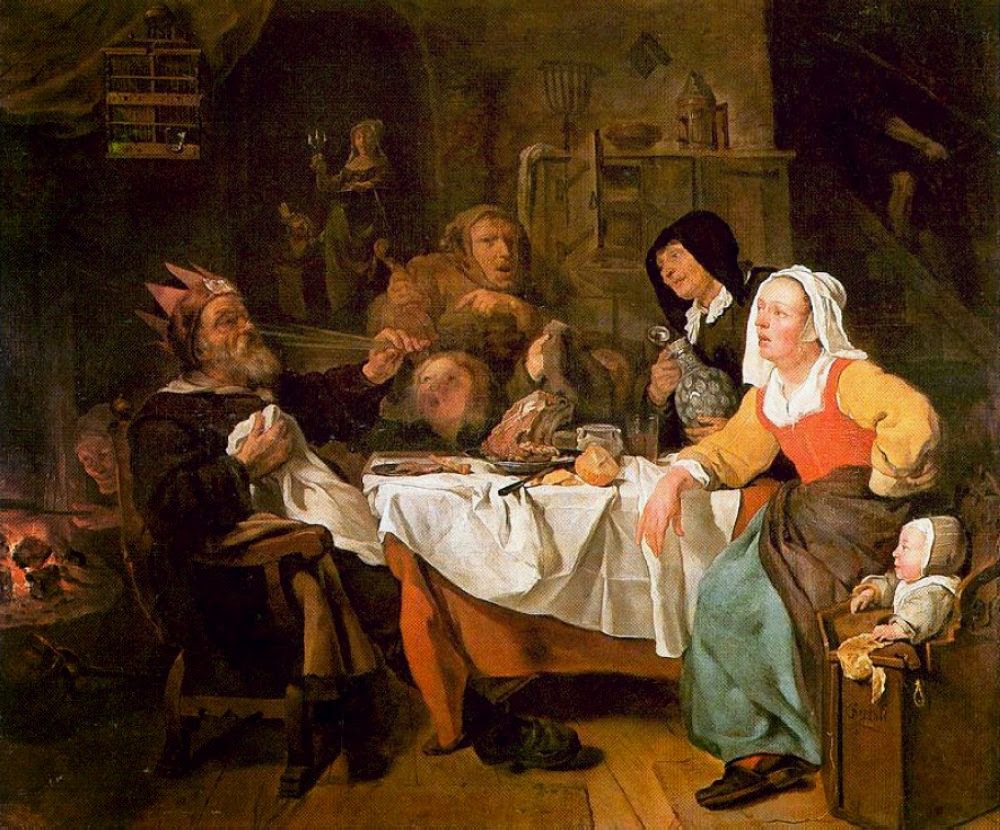
It's January 5, the Twelfth Day of Christmas, and tonight will be Twelfth Night. Like so many of our seasonal celebrations, its traditions have pagan origins.

In the past Twelfth Night was characterised by feasting and games, mumming and revelry. A Lord of Misrule was appointed as games master to preside--and command--the festivities. Plays and masques were presented (Shakespeare's Twelfth Night might have got its title from an association with court celebrations.)

Though now many people remove their Christmas greenery on or before Twelfth Night, in years past this was considered unlucky and the decorations remained in place until Candlemas (2nd February).

A special Twelfth Night cake was baked--the typical festive English fruit cake, perhaps decorated with elaborate icing and devices in almond paste--containing a pea and a bean. Those who received the hidden prize were crowned King and Queen.


Here is a 17th century recipe for A Very Good Cake:

Take 4 quarts of fine flour, 2 pound and a half of butter, 3 quarters of a pound of sugar, four nutmegs, a little mace, a pound of almonds finely beaten, half a pint of sack, a pint of good ale-yeast, a pint of boiled cream, 12 yolks and 4 whites of eggs, 4 pound of currants. When you have wrought all these into a very fine paste, let it be kept warm before the fire half an hour before you set it into the oven. If you please, you may put into it 2 pound of raisins of the sun stone and quartered. Let your oven be of a temperate heat, and let your cake stand therein 2 hours and a half before you ice it, and afterwards only to harden the ice. The ice for this cake is made thus: Take the whites of 3 new-laid eggs, and 3 quarters of a pound of fine sugar finely beaten, beat it well together with the whites of the eggs, and ice the cake. If you please you may add a little musk or ambergris.


O Apple Tree, O Apple Tree,
We've come to Wassail Thee!

 In England's apple-growing regions (Devon, Somerset, Herefordshire particularly) wassailing took place--and still does--in the orchards on Twelfth Night. After feasting on cider and cakes, a party would re-assemble under the trees to serenade them, sometimes banging on pots and pans. The purpose was to drive bad spirits out of the orchards and ensure a good autumn harvest.

Other areas had specific local traditions--processions, or a form of trick-or-treating or begging for favours.


Syllabub


This was a popular drink at festive times, made from cream and eggs and wine. Here are two 17th century recipes for whipped syllabub:

Take a pint of cream with a little orange-flower water or 2 or 3 ounces of fine sugar, the juice of a lemon, the whites of 3 eggs.
Whisk these together and having in your glasses Rhenish wine and sugar and claret and sugar, lay on the froth with a spoon heaped up as light as you can.

Take the white of 2 eggs, and a pint of Cream, six spoonfuls of sack, as much sugar as will sweeten it; then take a Birchen rod and whip it; as it riseth with froth, skim it, and put it into the Syllabub pot; so continue it with whipping and skimming, till your Syllabub pot be full.


When I was little my mother often made syllabub during the Christmas season, and even though she used an old-fashioned churn like the one below instead of a special pot for the purpose or a "Birchen rod", it seemed to take forever for the whipping and the frothing to be finished. I don't remember whether the children's servings had wine!


For making the syllabub in the photo above, I used a wire whisk, and didn't froth it nearly long enough!

In A Pledge of Better Times, my novel of the 17th century royal court, a significant development occurs at a Twelfth Night ball at Kensington Palace in 1692. Here's a description of the event by a diarist of the period:


Great doings last night at Kensington in imitation of the apartments at Versailles, all the rooms were full of ladies and men . . . . Dice, cards and dance were the divertissements; tea, chocolate and other liquors, and sweetmeats were the entertainments and refreshments.

I hope you enjoy your own Twelfth Night revels!


Dec 4, 2014

Promotional Items


There will be giveaways, before and after the book launch. 


Sticky Notes


Coffee mugs


Luggage Tags


Also bookmarks, postcards, free books . . .


 Reminds me of an old favourite Dire Straits tune, Badges, Posters, Sticker & T-Shirts.


Nov 14, 2014

The Death of Nell Gwyn

Nell Gwyn (private collection)
When recently in England, I was able to view several portraits of Nell Gwyn, the actress-mistress of
King Charles II and mother of the 1st Duke of St. Albans,
the male protagonist of A Pledge of Better Times. This is one of them, less well known than others painted by Lely, Kneller, and other artists.

I won't attempt to recount her full biography, but any version makes for interesting reading. In short, she was a child of the slums, an orange- and apple-seller in a London theatre, a popular comic actress, mistress to England's lustiest king, and mother to two of his sons.

After her royal lover's death in February 1685, her health rapidly deteriorated. The previous year she wrote from her house in Windsor to a correspondent, "I have continued extreme ill ever since you left me, and I am so still. I have sent to London for a doctor. I believe I shall die." It is supposed that complications from intermittent or undiagnosed venereal disease was responsible for her frequent maladies during her last years. In the spring of 1687, a time of great worry and strife, a series of strokes left her incapacitated and bedridden. She composed her last will and testament in July, and added a codicil a few months later, on October 18th, with specific instructions about her burial and a few final bequests.

Nell died at 10 in the evening on 14 November in 1687 at her mansion in Pall Mall. She was thirty-seven, and had crammed a lot of living into a relatively short life.

She requested burial in the chancel of St. Martin's-in-the-Fields. She wanted Dr. Tenison, who was her support and her confessor during her months as an invalid, to preach the funeral sermon. He did, basing his text on the parable of the Lost Sheep from the Gospel of Luke.

Her charitable bequests included:

£100 to be distributed to the poor of the parishes of St. Martin's and St. James's by Dr. Tenison, especially for clothing the poor and the release of debtors from prison. (In today's money, this could be as much as £8500 or $14,500.)

£50 to be delivered by Tenison and her personal chaplain John Warner to two Roman Catholics to be given "for the use of the poor of that religion inhabiting the parish of St. James's"

£20 to be applied annually by her son the duke to release poor debtors out of prison every Christmas Day.

King Charles II (private collection)
 Her burial service took place three days after her death, on 17th November, when she was interred in the Vicar's Vault. The funeral expenses were £375, paid by Sir Stephen Fox.

Her debts were massive. Immediately after King Charles's death she was in grave danger of being outlawed as a debtor. While the King lived, she spent freely from the income he provided for her maintenance and that of her son. Although he died before he was able to elevate her to the peerage as Countess of Greenwich, he had bestowed several valuable properties upon her. Her son, who had to contend with her creditors, was obliged to sell her fine house in Pall Mall. Burford House in Windsor, where she usually passed the summer, was leased to Princess Anne and her husband Prince George of Denmark while the duke was a minor.

King James II (private collection)


Bestwood Park in Nottinghamshire, a hunting lodge, was heavily mortgaged, and in compliance with his late brother's deathbed request that he "not let Nelly starve," King James II paid off the mortgage after his accession.


Nell's death inspired many verses, of dubious quality but with the intention of expressing her "whore with a heart of gold" persona.


From "Laurinda, a Pastoral on the Lamented Death of the Incomparable Madam Gwyn":

'Twas always spring, for when the sun retired,
Her warmer beams the vocal groves inspired
Her cheerful looks the winter's rage beguiled,
Her smiles made summer, and she always smiled.

And "An Elegy in Commemoration of Madam Eleanor Gwyn" declares:

. . . some may cast objections in and say
These scattered praises that we seek to lay
Upon her hearse are but the formal way.
Yet when we tell them she was free from strife,
Courteous even to the poor, no pride of life,
E'er entertaining, but did much abound
In charity, and for it was renowned . . .

I recently had an interesting conversation with one of her descendants, who speculated about the reaction of the court if King Charles had lived to transform the lowly, brothel-reared playactress into Lady Greenwich. If he had done so, her enduring legend might have been a different one. In the popular imagination, she seems to live on as "the people's mistress," the commoner who consorted with a king, amusing him and his courtiers with her spirit and her wit.

Charles Beauclerk evidently exhibited his parents' flair for repartee. As an adult, the duke was described as having inherited the King's "humour and entertaining Wit, which none of his other Children can boast." In Queen Anne's reign, another former royal mistress observed "the Duke of St. Albans a-jesting" one dull evening when the court was at Windsor.

Charles Beauclerk, 1st Duke of St Albans
(private collection)


Nell makes a few appearances in A Pledge of Better Times. Writing about the decline and demise of so vital a creature was moving and challenging.


Sep 30, 2014

How to Help--and Receive Rewards!

I've inaugurated a Kickstarter campaign to fund the promotional activities and the launch of A Pledge of Better Times.

Background about the novel, a little film, and more information here:

A Pledge of Better Times on Kickstarter


Sep 27, 2014

My Book Has A Cover!

And what a cover it is! I'm so thankful that H.M. the Queen and the Royal Collection granted a licence so that I could use the portrait of Diana, Duchess of St Albans. It hangs at Hampton Court Palace where I visit it--her--at every opportunity.

More information about the book will be forthcoming. It is scheduled for release in April 2015.