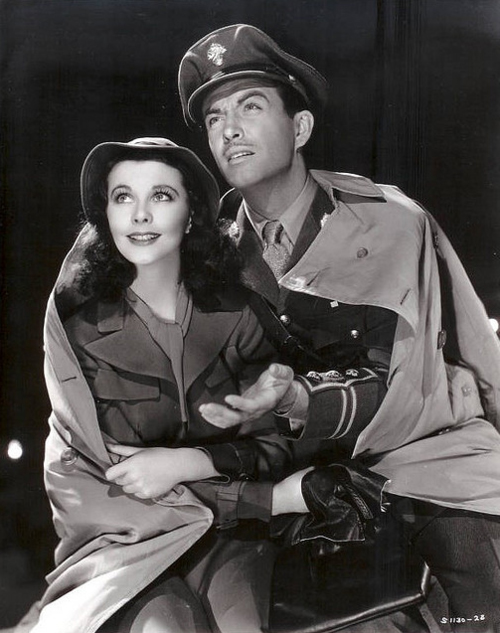
Waterloo Bridge movie poster
How it Started
The story originated as a 1930 stage play by Robert Sherwood, which he based on his wartime experience with an English chorus girl. His main character, American chorine Myra Deauville, is unable to perform in London during World War I and turns to prostitution, meeting servicemen on Waterloo Bridge. Her boyfriend is Canadian soldier Roy Cronin, who doesn't realize she's dwelling in a brothel. Her comrade Kitty advises him to marry her. The landlady sees it as a chance to get money she's owed, but eventually informs Roy that Myra is a harlot. Nonetheless, he makes her the beneficiary of his life insurance, should he be killed in action. But Myra is the one who dies--on the bridge--during a German bombing raid.
The original Pre-Code film version, directed by James Whale, starred Mae Clark as Myra and Ken Douglass as Roy. In one of her earliest performances, Bette Davis appears as Roy's sister. The set-up tracks closely with the play, with the addition of Roy's mother, to whom Myra confesses the truth about herself. She runs off to London, Roy follows and proposes, the landlady reveals that Myra is a prostitute, but Roy hunts her down and on Waterloo Bridge asks her to marry him anyway. Before he's taken back to the army by military police, she agrees. An air raid begins, and she's killed on her way to a bomb shelter.
Background to the Remake
David Selznick of his eponymous production company purchased the rights to the play, and MGM subsequently obtained them. To repay his father-in-law's studio for assistance in making Gone with the Wind, Selznick loaned out Vivien Leigh, who expected her co-star to be her lover Laurence Olivier, but he was unavailable. Robert Taylor was cast, much to her disappointment. They had worked together a couple of years previously, in A Yank at Oxford, filmed in Denham England at MGM's studio there and released in 1938. (Thus, "They're back again" on the movie poster pictured above.) Mervyn Leroy directed. Ultimately both Leigh and Taylor, who got on well, regarded Waterloo Bridge as their favourite film.
Joseph Breen of the Hays Office, upholder of the Production Code, was adamant that aspects of prostitution be eliminated. Filming took place in the first quarter of 1940, and the picture was released in mid-May.
Leigh and Olivier needed the money from their respective film projects to fund their ambitious full-length stage production of Shakespeare's Romeo and Juliet, which they would open in New York before touring nationally. Vivien's repertoire of tragic and often suicidal heroines had begun with Hamlet's Ophelia, followed by Myra Lester of Waterloo Bridge, and soon thereafter, Juliet. In future, she would depict Cleopatra in George Bernard Shaw's Caesar and Cleopatra (on film and on stage), and in Shakespeare's Antony and Cleopatra (on the stage). And she would garner her second Academy Award as the troubled and unstable Blanche duBois in Streetcar Named Desire by Tennessee Williams.
In 1956, a happy-ending version of Waterloo Bridge was released: Gaby, starring Leslie Caron. The action of the story was shifted from World War I to World War II.
The 1940 Waterloo Bridge
On September 3, 1939. Britain has declared war on Germany, and a loudspeaker instructs the crowd about about what to do during an air raid: blackouts, shelters, gas masks, thermoses, care of children, pets, evacuations.
On the way to Waterloo Station, to embark for battle in France, Colonel Roy Cronin asks his driver to take him first to Waterloo Bridge. Gazing on the river, he pulls out a small Asian ivory charm, and reflects on his past during the prior war....
During World War I, Roy encounters Myra Lester and a troupe of ballet dancers on Waterloo Bridge during an air raid. On their way to the shelter, Myra drops her purse and dives to grab her luck charm, nearly being hit by a vehicle. While sheltering, she and Roy chat and are mutually attracted but exchange first names only.
Publicity still, Leigh & Taylor costumed for their first meeting
Later that evening, Roy attends Myra's ballet performance.
Myra and bestie Kitty (Virginia Field) in the ballet
Publicity still of Taylor and Leigh
Publicity still, Myra as dancer
Roy gets two days leave, returns, asks Myra to marry him--he also has to ask for her surname. He informs his stuffy regimental officer of his intentions. The older man insists that Roy get permission from his commander-in-chief (a duke, who also happens to be Roy's cousin), and is reminded that he's heading to the front in two days. The duke, even more class conscious, is appalled to learn that Myra hails from Birmingham and is a dancer--in his day, dancers were for dalliance, not marriage. The couple hasten to the church only to learn that nuptials are prohibited at that hour, and the vicar advises them to return the next day.
Myra hurries to the dancers' boarding house to pack all the items she has purchased for her trousseau. She tells her chum Kitty she's being married tomorrow. Roy telephones to say his leave is cancelled and he departs in twenty-five minutes. In order to say goodbye, Myra will have to skip her performance.
Lobby card: Madame (Marie Ouspenskaya) upbraids defiant Myra
Madame, outraged by Myra's truancy, fires her--and Kitty, before the troupe departs for America. Both girls try for any job they can find--dress shop, tea shop--with no luck. Kitty says Myra should let Roy know about the dire straits she's in, he could help. Kitty is fearful, but Myra is too proud to ask for help.
Roy sends flowers via a friend, with a letter saying his mother is bound for London and wants to see Myra. She decides to meet Lady Margaret Cronin at an upscale teashop. While waiting, Myra glances at a newspaper list of war dead--Roy's name is on it. She faints from the shock, but recovers consciousness. Lady Margaret arrives, apologises for being late, and expresses how much she's wanted to make Myra's acquaintance. A shaken Myra conceals her discovery, unable to bring herself to inform the older woman that her son has been killed. Her odd behaviour leads Lady Margaret to think she doesn't want to be friends yet, and she departs. Myra faints again.
Without employment as a dancer, or anything else, and no Roy, from desperation she follows her friend Kitty's example and becomes a streetwalker.
A long time later, on her regular evening rounds, she crosses Waterloo Bridge and heads inside the train station in search of a customer among the returning soldiers.
Myra the prostitute at Waterloo Station as soldiers return
Unexpected reunion with Roy
Because Roy lost touch with Myra, he's startled that she knew he was returning that day.
The face of shame, but she can't let on why
He takes her to a place to get some tea and catch up. While Myra weeps, he explains he lost his identification when wounded, and was in a German prison camp for the better part of a year. His mother came to Switzerland to retrieve him on his release and admitted she's lost contact with Myra.
The face of guilt
Myra covers her purpose for being at the railway station by saying she was there to meet a friend--a girl. He wants to know if she's got a job--not that it matters, she has to quit so they can marry. He will never leave again and make her life easy from now on. And he rushes to the nearest phone to tell his mother they'll be traveling to Scotland on the next train that night. While he's away, she rubs off her makeup.
The face of uncertainty
Myra feels she has to confess what she's done to survive. She tries to tell him she can't go to Scotland with him. He assumes there's another man in her life, but she denies it and professes her abiding love. That's enough to satisfy him. She decides to accept her good luck and let him take her shopping, and to Scotland to join his mother.
When Kitty leans what has happened, she wonders if Myra can "get away with it"--not telling Roy that she prostituted herself during his long absence. Kitty advises Myra to go with him.
Roy's estate Scotland is palatial. Lady Margaret is thrilled to see her son, and warmly greets Myra. The neighbours attend an evening party to meet the bride-to-be and welcome the hero home from the war. The wellborn girls, wallflowers all, look down on Myra for being a dancer. Roy and Myra waltz together in a haze of happiness and passionately kiss in the garden. Myra declares she is happy, but Roy believes he sometimes sees fear in her eyes--believing it is because of whatever she endured during her solitary year on her own.
His cousin the duke is there and is entirely enchanted by Myra, inviting her to dance with him. She knows why he's so attentive: to clear her way with the condescending locals. He tells her they all think dancers are "racy"--which of course makes her painfully aware that a former streetwalker is an even racier and more shocking choice of bride.
At Roy's ancestral home with his mother (Lucille Watson)
After the party, alone in her bedroom, she is torn about by guilt at her deception. Lady Margaret appears, wanting to clear the air about their London meeting. Her ladyship regrets not being kinder that day, and confesses she later realized that Myra had already known Roy was dead. After receiving a friendly kiss and being called daughter, Myra breaks down and declares that she can't marry Roy. She has to go away and never seen him again. Lady Margaret probes into what could be so terrible, before the awful realization dawns. And yet she blames herself for not finding Myra and helping her. She promises she'll never tell Roy about Myra's past.
On the way back to her bedroom, Myra encounters Roy, who returns the good luck charm she gave him in the air raid shelter on the night they met.
By morning she's gone, having left behind a farewell note. Roy races to London to find her. At the boarding house, he finds only Kitty, who hasn't seen Myra at all. He demands an explanation about what troubles Myra. After some protests, she takes Roy on a tour of her missing friend's usual haunts--bars, dance halls. Waterloo Station. No one has seen her. And by now Roy understands all too well. But he will always search for her, until he finds her.
Myra is on Waterloo Bridge, staring down at the river. An encounter with an aged streetwalker proves to her that she has no prospects of happiness, ever. She throws herself in front of a convoy of medical vehicles. Her good luck charm lands on the pavement.
In 1939, the older Roy clutches it--proof that he's aware of her tragic fate--in remembrance of his great lost love.
Reception
The film was hugely popular with the public and made a profit of nearly half a million dollars, receiving Academy Award nominations for Cinematography and Original Score.
Vivien Leigh's performance was widely regarded as an admirable follow-up to her spirited performance in Gone with the Wind. As Myra, she exhibited an even wider range of emotion than she had as the stubborn, determined, ambitious, and hard-edged Scarlett. Her character was a softer creature, one who called for a demonstration of humour, charm, charm, hopefulness, joy, grief, desperation, guilt, and self-sacrifice. Robert Taylor received by far the most positive notices of his career.
New York Times: "...the remarkable Miss Leigh ...as fine an actress as we have on the screen today. Maybe even the finest."
Los Angeles Times: "A woman's tragedy that is brilliantly delineated, with Vivien Leigh, of Scarlet fame, as interpreter, and Robert Taylor doing his best picture performance...Should appeal to a very wide audience."
The Minneapolis Star: "A love story which demanded tenderness, sincerity, and deft acting. Miss Leigh delivers beautifully in all departments...Robert Taylor...may somewhat be overshadowed by his co-star, but that won't hide the fact that his is perhaps the best performance of his career."