Welcome to the English Historical Fiction Authors "Crazy Customs" Blog Hop, marking the publication of
Castles, Customs, and Kings, Volume 2. (Ordering information posted below!)
Marriage customs of 17th Century England might or might not seem crazy today...although several of them could certainly be described as unusual.
The Ceremony
The marriage
rite of the Book of Common Prayer came into being in the 16th century, and in 1660 a new version was published—its language is familiar to us today. The woman received a wedding ring as part of the ritual (the man did not). The best description of its symbolism comes from Henry Swinburne, who
wrote in 1686: “The form of
the wedding ring being circular, that is round and without end, imparteth thus
much, that their mutual love and affection should roundly flow from one to the
other as in a circle, and that continually and forever.”
As the groom spoke the line, “With all my
worldly goods I thee endow,” he placed a coin or a purse onto the cleric's prayer book. On one occasion in 1680, the purse contained 200
guineas—a small fortune! On a more mercenary level, this was equally symbolic of the fact that
so many marriages—whatever the couple’s social class—were arranged by parents
or guardians or even landlords or masters.
 |
Princess Mary of England & Prince William
of Holland, married at ages 9 & 15 |
On leaving
the house for the church, or the church itself, money was often distributed to
people gathered in the street, and paid to the musicians (frequently they were
trumpeters) heralding the newlyweds or playing at the wedding feast.
If the bride
was extremely young, she and her groom might live apart for a period of time.
John Evelyn, aged 26, left his 12-year old spouse and spent four years
travelling before taking up the role of husband. The Princess Royal, daughter of Charles I, seen here at the time of her wedding in 1641, remained in England for a year after marriage. After joining her husband in Holland their marriage was not consummated for a further three years.
The
Celebration
Very little has changed since the 1600s. After the ceremony people gathered for a
wedding feast, featuring wine and spirits, elegantly decorated and arranged
tables of food, cakes, music, and dancing. The earlier ‘bride pie’ gave way to
cake in the 17th century. Rather, cakes. The bride cake was larger
and more elaborately iced, with egg white and sugar, and decorated. The groom
cake was a plainer fruitcake, which was diced up and presented to guests in a
small box, as a lucky souvenir.
Prohibitions
Marriages weren’t
supposed to occur during Advent and Christmas, though records reveal that this was
not uniformly followed in the 17th century. Therefore late
November, before the First Sunday in Advent, was a popular time for a wedding. After St Hilary’s
Day, 13th January, marriages resumed.
There was a similar prohibition in Lent, the most solemn of liturgical
seasons. Perhaps this fact, in addition to the popular lore connected with it,
made Valentine’s Day the choice of some couples. Marriages were again permitted
from the Sunday after Easter. April was therefore a very popular month—partly
because Lent had ended, but also because May marriages were regarded as unlucky.
Then, as now, June was also a month for weddings.
Also considered unlucky—and highly inconvenient—by country folk, was the
period between haymaking and corn harvest, July through early September.
Weddings of
Court and Commonwealth
The first Stuart monarch, James
I, was mad for weddings. He played matchmaker to some of his courtiers, helping
his male favourites to marry into money, and he hosted their marriage
celebrations in his palaces—often with a masque as well as a banquet. On one
occasion, in 1617, at the conclusion of festivities he commanded that the
couple should extend their wedding night till noontime, adding that he would
join them in bed in the afternoon to hear the details of the consummation. The bride
was fourteen—how embarrassing it must have been for her—and the
bridegroom twenty-six.
Charles I also hosted weddings
at court. The beauteous Mary Townsend was daughter of Aurelian Townsend, poet
and creator of court masques (and, incidentally, grandmother of Lady Diana de
Vere of A Pledge of Better Times). Her 1646 marriage to George Kirke, Groom of
the Bedchamber and Housekeeper of Whitehall Palace, took place in the royal
presence during the Civil War, when the court was at Oxford. This wedding of
courtiers took place in Christ Church Cathedral, and King Charles gave away the
bride—a mere three years before his execution. Mary, who remained at court
throughout the next three reigns, did not live up to her vows of fidelity: “A beautiful wanton whose reputation did not improve with the years.”
During
the Commonwealth marriage was no longer a church sacrament but a civil
contract. To be legal, it had to be conducted by a justice of the peace. The
banns could even be cried in the marketplace rather than in the local parish.
Sundays, previously an acceptable day for a marriage, were disallowed—a
prohibition still in force in the Anglican tradition. After 1656, weddings
could again take place in church.
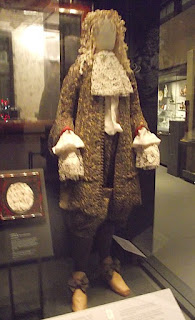 |
| Duke of York's wedding suit |
Following the Restoration, during the riotous reign of Charles II,
marriage was deemed a necessity for procreation and accessing a title or
fortune. The ceremonies might be lavish and costly, but fashionable people
sought sexual pleasure outside the bonds of marriage.
Royal
marriages, when the couple lived in different lands, could take place by proxy
in the bride’s location, with a second ceremony immediately upon her arrival in
her new husband’s country, as with James, Duke of York (later James II) and his
second wife, Mary of Modena. At their court wedding in November, 1673, her
bridegroom wore this lavish costume, on display at the Victoria and Albert
Museum in London.
The
great painters of the day produced marriage portraits, either immediately
before or immediately after the wedding.
Normally
the couple were painted individually, although double portraits can indicate a
recently-wedded couple. The first double portrait
below shows the 2
nd
Viscount Bayning and his wife in a gown very much like one a bride would have worn
at her wedding, and the presence of Cupid presenting a floral garland hints at matrimony as well. The second, by Peter Lely, nearly a copy of the first, depicts the Baynings' daughter and heiress,
Anne, with her husband Aubrey, 20
th Earl of Oxford de Vere (father of Lady Diana de Vere, and a prominent character in
A Pledge of Better Times). They
married in in 1647 when Anne was ten years old and Aubrey twice her age. Their
portrait, attributed to Peter Lely, is dated 1650, and could be indicative of
their beginning to live together as husband and wife.
Private
Marriage
In contrast
to the ostentatious court weddings, persons of distinction often preferred a
very private ceremony attended only by the closest of family member and
friends. The union was sometimes not made public until after it occurred.
According to one letter-writer in 1667, “Yesterday the Earl of Manchester and
the Countess of Carlisle were privately married. It is owned by them today.”
And the timing of the private ceremony was less restrictive than a grand one,
as reported by the same correspondent: “Today or tomorrow Sir Greville Verney
will marry Lady Diana Russell.”
Those whose
marriages lacked royal sanction also preferred to exchange vows covertly. A
member of the Fleming family wrote from town in 1670, “On Saturday last, Lord
Dunkellin, eldest son of the Earl of Clanricarde, was privately married to the
Court Beauty, the youngest daughter of Mr. Bagnall. It has abundantly furnished
the Court and the city with discourse, but has not at all pleased Their
Majesties, who have suspended both of the Bagnalls, father and son, from their
attendance at court.”
After
wedding and bedding, a married couple would typically embark upon a journey to visit
relations not present at the ceremony, as described by diarist John Evelyn:
27 April
1693. My daughter
Susanna was married to William Draper, Esp. in the chapel of Ely House by Dr
Tenison, Bishop of Lincoln. I gave her in portion £4000, her jointure is £500 per ann…Much of this week spent in ceremonies, receiving visits and entertaining
relations, and a greate part of the next in returning visites.
11 May 1693. We
accompanied my daughter to her husband’s house, Adscomb, near Croydon, where
with many of his and our relations we were magnificently treated. There we left
her in an apartment very richly adorn’d and furnish’d, and I Hope in as happy a
condition as could be wish’d, and with the great satisfaction of all our
friends…
Wedding
Clothes
The bride’s
family provided new clothing suitable to her status, and certain household
items, in addition to whatever dowry she might have. Early in the century souvenirs, or wedding
favours, were obtained by cutting away the ribbons or embellishments of the
bride’s gown. Later the family ordered true love knots made up in advance for
distribution ahead of time or at the wedding feast. These colourful rosettes
and cockades—usually blue—were pinned onto the hat or headdress or coat of
friends and family and publicly worn for days afterwards. According to a French
visitor: “The greatest Noblemen give them not only to those that are at the
wedding, but to five hundred people besides; they send them about, and
distribute them at their own Houses.”
Gloves,
white or yellow, were also presented. At the wedding of John Manners to Lady
Anne Pierrepoint in 1658, a dozen pairs of yellow gloves were ordered to
distribute to the guests.
On the day,
the bride wore her best gown, or a new one, depending on her status. The colour
preferred by the wealthy was silver, which prior to the Victorian white wedding
gown, symbolised purity. Her bride-maids’ attire would be similar to hers. The
groom, his family, and his bride-men would also display their standing in
society through their garments.
Middling and
Lower Classes
There are
written descriptions of weddings for merchants and tradesmen, indicating that these are
occasions of community coming together, as with the upper classes. These weddings were as much alliances of family interests as much—if not more—than simply the union of the two individuals at the altar.
There is a
dearth of records of weddings for the unlettered masses. Most could be
described as a ‘penny-bridal,’ in which a tavern-keeper might provide the
couple with a gathering place—and a lodging for the night—in exchange for the
money to be received by their guests for ale, wine, and food. The festivities
were merry—contests, foot-races to and from the parish church—and generally
included a bawdy bedding ritual, with jesting and serenading on the other side
of the bedchamber door or beneath the windows.
Dutch and
Flemish painters created vivid scenes of villager weddings and feasts during
this era, and the Marriage at Cana was a popular subject for religious art,
sometimes with the characters in contemporary clothing. English wedding scenes are a rarity prior the 18th century.
 If you enjoy reading about customs of the past in England, this book is for you!
Castles, Customs & Kings on Amazon US
Castles, Customs, & Kings on Amazon UK
Be sure to follow the other Blog Hop links for fascinating information from all the other participants!